Compose at the piano, get the score
Record your ideas at the keyboard and get them back as notation and MIDI.
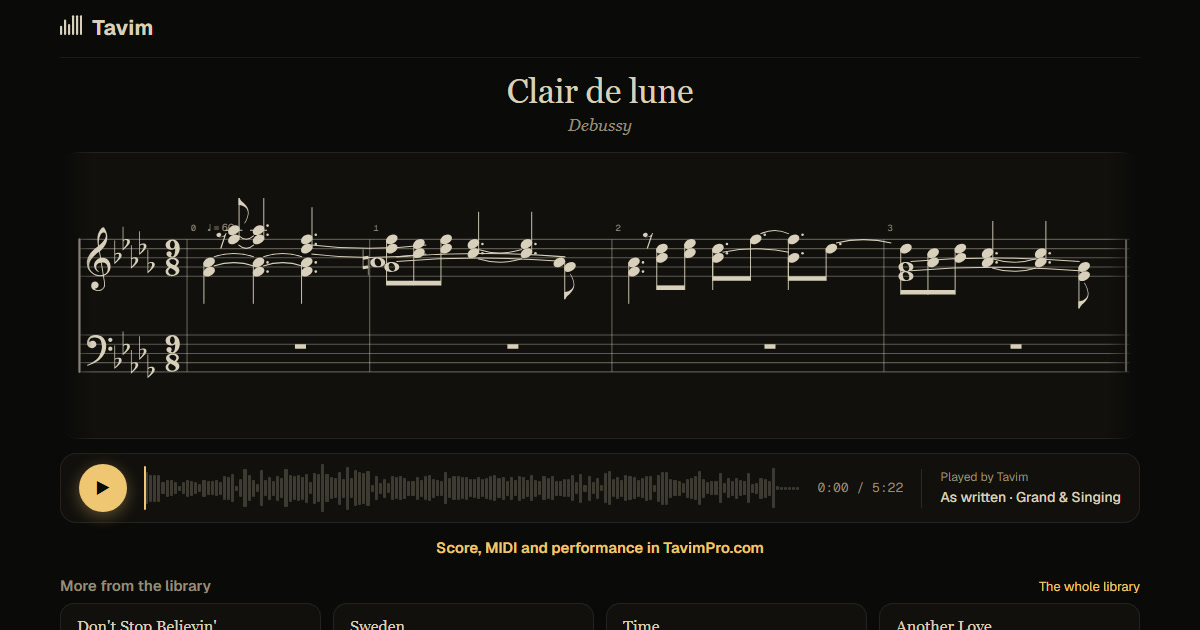
What you get
Your idea as a score, both hands, in bars, with the key, metre and tempo, and as MusicXML for MuseScore, Sibelius, Finale or Dorico.
As MIDI: for your DAW with the notes on the bars, or aligned to the recording with every note where you played it, its loudness and the pedal. And the playing replayed on a clean piano, to hear the idea without the room.
Writing ideas down by hand breaks the flow. Record instead, and let Tavim write the draft: you keep playing while it works, then read the score with the notes lit and correct what it misheard, a note's pitch, octave or length, or the hand it is in. The MIDI and the score agree note for note.
Share an idea as a link: whoever opens it hears it replayed on a clean piano and follows the lit score, on a phone or a computer, without an account. Export the replay as MP3 or WAV for a quick demo.
How it works
- Record the idea and drop the file on Tavim.
- Tavim writes every note you played.
- Correct what you need on the score and export MusicXML or MIDI.
What works best
Piano alone works best. Recordings up to an hour are taken.
On your own music the bars are Tavim's best reading of the time; expect to tidy them in your notation software.
Record the piano alone if you can; with other instruments, Tavim separates the piano first. Audio and video files in most formats are taken, up to 2 GB a file.
Your projects are private to you until you share a link. Tavim is free while it is in beta: 50 actions a month, and a new transcription is one.