Tavim · how it works
The guitar, written down
Guitar is the hard instrument to transcribe. Here is why, and how far we got.
Why guitar is hard
A piano has one key for each note. A guitar can play the same E on four different strings, and each sounds different. A strummed chord is six notes that begin a few thousandths of a second apart. A bend slides between two notes without stopping at either. A string still ringing is struck again. On an electric guitar, distortion covers all of it.
A transcriber built for piano hears a guitar as a blurred piano.
The same idea, a new instrument
Tavim's guitar model grows from the idea behind its piano model: for every note, learn where it is written and when it was played. We trained one model for acoustic guitar and one for electric, because they are different instruments played by different people.
Inside each model there are two listeners. One hears notes. The other writes a score. Where they agree, the note is certain. Where they disagree, the score writer decides, because it hears the guitar part and not the band around it. On electric guitar it decides throughout.
Then the hand. Tavim chooses strings a guitarist can actually reach: one note per string, a hand that spans a few frets. It hears the tuning of the instrument first. And it times a strum string by string.
How far we got
- Notes right: 91 of 100 on solo acoustic guitar, 89 on electric. That is level with the best result ever published, and close to the limit of the test itself.
- Notes in the right place in the bar: 39 to 50 in 100 at exactly the written position, against 13 to 14 when notes are snapped to the beat. We know of no one else who publishes this number. We do, because it decides whether a guitarist can read the result.
- The right string: 76 times in 100.
- The tuning: found 86 times in 100.
- A strum: each string's start timed to 6 thousandths of a second.
Why 91 is not 100
Part of the answer is the test. Its reference was made by automatic detection from a special pickup, and where the reference and the recording disagree, a transcriber is marked wrong for being right.
The rest is the guitar. Most of what Tavim still misses lies inside strummed chords, where an inner string is covered by its neighbours. Next come a ringing note struck again, and a bend heard as the fret beside it.
What you get
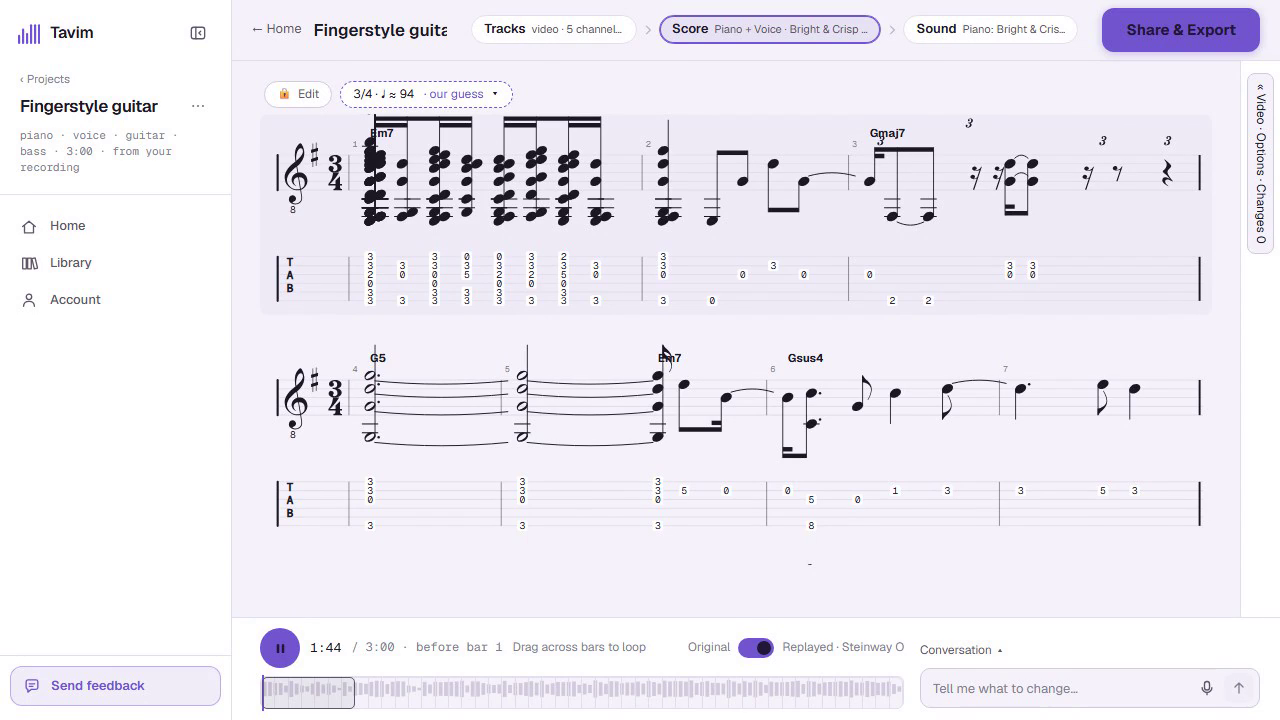
Notation above tablature, bar by bar, with the tuning named. A MIDI file that keeps the strum. And the notes lit as the recording plays.