Tavim · how it works
Right notes, unreadable page
The goal we set for Tavim's scores, the three principles behind it, and what it cost us.
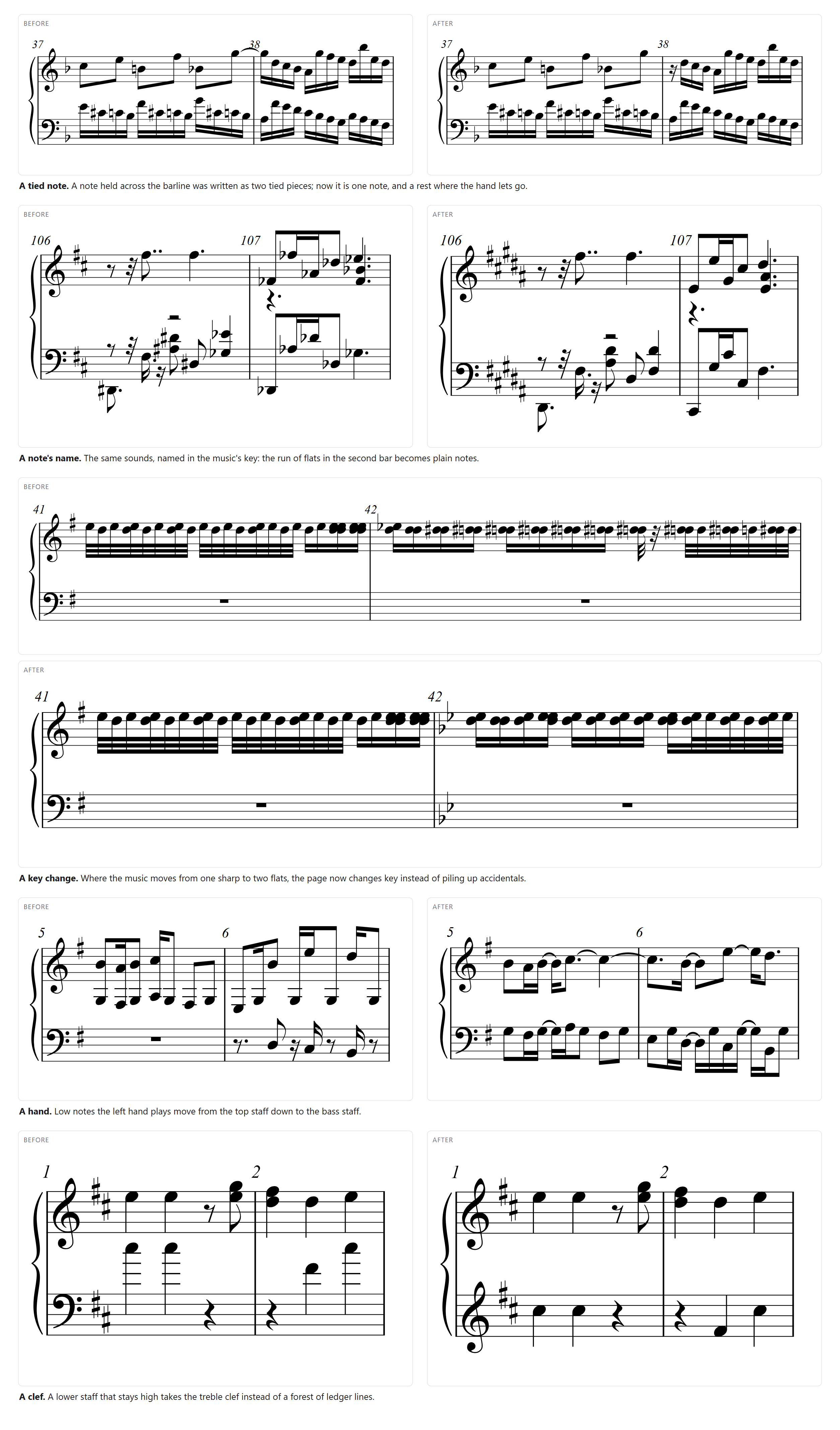
Our first scores had every note right, and no pianist could play from them. A held note was four small notes tied together. A piece in A-flat was written in sharps. The left hand's melody sat on the right hand's staff, six lines under it.
A long list of rules that fixed nothing
We did what everyone does. We wrote a rule for each ugliness: one for ties, one for accidentals, one for clefs. The list grew long. Each rule fixed its case and broke another, and the pages looked no better. Every rule was treating a symptom.
The goal
So we wrote the goal down first. A page a pianist can read at sight. Not the page a publisher printed. A clean page matters more than an identical one, by a lot.
Three principles
- Write what was played, in the simplest way it can be written. The fewest signs on the page for each note heard. One long note is one long note.
- Timing belongs to the performance, not to the page. How the player stretched a phrase is kept, exactly, beside the score. The page stays clean because the performance layer carries the rest.
- When the page gets complicated, the grid is wrong. Many ties across bar lines do not need a tie rule. They mean the bars are in the wrong place. Find the right metre and the page arranges itself.
Where the music itself does not decide, simplicity does: the key signature that cancels the fewest notes, the clef that needs the fewest ledger lines, a trill as a sign and not as thirty-two tiny notes.
What it cost
We gave up the printed edition as our target. The standard measure in this field is distance from the published score, and we watched ours stop improving while the pages became much easier to read. A published edition is one editor's good choice. It is not the only right way to write a piece.
We also gave up cleverness. Tavim does not propose five-four or seven-eight on its own. If you know the piece is in seven, you say so, and the score is rewritten.
What it bought
On our test pieces, rhythms that fight the metre fell from 19.5 to 8.2 in every 100 notes. Accidentals fell from 6.6 to 5.1, ledger lines from 33 to 25. The notes did not change at all: the same hearing, a cleaner page, and 18 seconds a take where it was 29.